


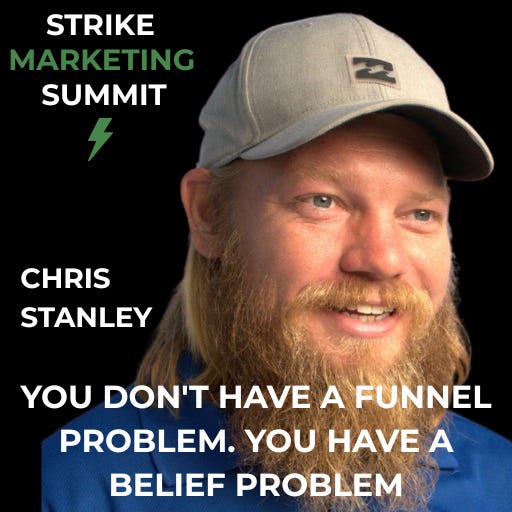
This article is a recap of Chris Stanley’s session at the Strike Marketing Summit on December 12, 2024. Chris is the founder of IA Path and Mini Book Publishing, the author of 21 Amazon bestsellers, and the architect of a $700K/year online business he runs from a sailboat. His new book, Mini Book Flywheel*, drops in January 2026. Get his free mini books at minibookpublishing.com/free.*
On December 12th, the Strike Marketing Summit audience heard a line that reframes everything:
“Funnels cash in on belief, but flywheels are what actually create the belief in the first place.”
That’s Chris Stanley — founder of Mini Book Publishing, author of 21 Amazon bestsellers, and the man who built a $700,000-per-year online education business from a sailboat in Florida, starting with a 10,000-word book he wrote about insurance adjusting. His revenue has held at that level for three consecutive years. Not through ads, not through a breakthrough launch, not through a viral moment. Through a flywheel.
When Chris finished, I thought: this is the session that explains why so many great founders stay stuck. Not because they’re bad at marketing. Because they’re running the right tool against the wrong problem.
“Funnels Cash In on Belief. Flywheels Create It.”
Here’s the distinction in plain terms.
Imagine someone is fed up sleeping on their old mattress. They search “Purple Mattress” on Google, meaning to buy it. You’ve placed an ad on that search for your competing mattress. They click. Maybe they buy. You’ve just made a sale — but you didn’t create any belief. You borrowed it. The buyer already believed a new mattress would fix their sleep. You funneled their existing conviction toward your brand.
That’s what funnels do. And Chris is clear: funnels are not the enemy. “Sales funnels are valuable. I make money with sales pages and upsells and downsells... but they cash in on belief. And most of us don’t have any belief yet. That’s why we’re not making any money with our sales page.”
The problem is that bootstrapped founders in new categories are trying to use a belief-conversion tool when they don’t have any belief to convert yet. “Maybe we’re creating new categories, and so we’re trying to create belief in something that does not even exist yet. Funnels cannot do that. You have to have a flywheel to create belief.”
This is the whole talk in two sentences. Everything else is the mechanism.
The Three Problems Every Founder Faces — In Sequence
Before Chris got to the solution, he named the three problems that stop founders from getting traction. Most founders experience these as one undifferentiated struggle — “my marketing isn’t working.” Chris breaks them apart so you can see exactly where you’re stuck.
Problem 1: The Credibility Crisis
Chris started IA Path (his insurance adjuster education company) in 2016. Before he wrote his first book, people were attacking him on LinkedIn. “Who are you to give advice? Have you even ever done this job before? What’s your adjuster license number?” He had the expertise. He had done the job. He just had no proof that the market could recognize.
That’s the credibility crisis: the gap between what you know and what the world believes about you. It’s not a confidence problem. It’s an evidence problem. “No one trusts you. If someone won’t spend $3,000 with you even though you can help them make $10,000 — that’s why. They don’t believe you.”
Problem 2: The Tornado Trap
In his attempt to solve the credibility crisis, Chris did what almost everyone does: he launched things. “I probably sold 10 products that year. Well, didn’t really sell many of them, but I tried to sell at least 10 different products and services that first year and I was so burnt out. Everything I applied was very short-lived. Nothing really seemed to take.”
Chris compares sales funnels to tornadoes. They have a lot in common. Tornadoes spin up fast — they generate enormous energy almost instantly. They also die fast. A really long-lasting tornado stays on the ground for 10 minutes. Most last 30 seconds. The trap is that every new launch feels like it could be the breakthrough. You change the button color, rework the headline, try a different traffic source. But the underlying problem — belief — hasn’t been solved.
“A tornado is not a weather system. It’s a part of a weather system. It has borrowed energy.” Funnels borrow demand that already exists in the market. If you don’t have an existing category with established demand, there’s nothing to borrow from.
Problem 3: Category Confusion
The third problem is the subtlest and most damaging in the long run. If people can’t clearly identify what you are, they don’t remember you — and they don’t buy from you.
Chris’s test is simple: “If you’re especially a one-person solopreneur, and someone can say, ‘oh, you’re the blank guy’ or ‘blank gal’ — you’re on track. But if that isn’t there, you’re not making it.” He’s the mini book guy. Fernando is the strike marketing guy. If someone can’t complete that sentence for your business, you have a category confusion problem.
Category confusion usually masquerades as a messaging problem. It’s actually a positioning problem at the category level. You haven’t staked out a clear space, named it, and given the market a way to remember you for it.
Tornadoes vs. Hurricanes: Choosing Your Weather System
Chris is obsessed with weather — a natural consequence of living on a sailboat in Florida and spending years as a catastrophic insurance adjuster who got deployed after storms. The meteorology metaphor isn’t decorative; it comes from someone who actually watches hurricanes form.
Tornadoes: form fast, intense but brief, small impact area. Hurricane Dorian in 2019 stalled over The Bahamas for an entire day and never made landfall in the US — yet its impact zone was as big as the state of Florida. “That hurricane was as big as Florida. Massive impact area.”
Business tornadoes (funnels) can generate a burst of sales. But they require constant new energy — new traffic, new creative, new campaigns — because they die fast. Hurricanes (flywheels) build slowly and sustain themselves. The impact compounds over time rather than dissipating.
And here’s the detail most people miss: when a hurricane makes landfall, it spawns its own tornadoes. “Hurricanes when they land... actually throw out their own tornadoes. So a lot of times the most devastated areas are from tornadoes that spun up from the hurricane.” Funnels aren’t bad — they’re just most powerful when they spin up from a flywheel that’s already in motion. The sequence matters: build the belief first, then cash in with funnels.
The Five Elements of a Hurricane-Strength Flywheel
Chris walks through what it takes for a flywheel to actually form and sustain. Just like a hurricane needs certain conditions to develop in the Atlantic, a business flywheel needs five elements:
1. Market need — warm water. Wade into the internet and look for the questions, frustrations, and unmet desires your audience is already expressing. Chris heard the same question 300 times in his first year: “That’s great, but how do I actually get work in this industry?” It took him 300 repetitions to recognize it. “It took 300 times for me to go, ‘oh, that’s what they want.’ And I wrote that book and that became the flywheel.”
2. A powerful point of view — the low-pressure center. “It’s a unique perspective that pulls attention. Like a bowling ball on a trampoline that sags right and everything rolls toward it.” Your POV isn’t a positioning statement. It’s a deep shift in how someone thinks about the problem — a way of seeing things that makes them want to hear more.
3. Consistent messaging — the rotation. If you change topics every week, the energy dissipates. If you repeat the same core ideas in different ways over time, the storm starts to spin. People start associating the language with you.
4. Belief echo — the acceleration. This is when people start repeating your message back to you — sharing your content, citing your framework, referring others to you because you’re “the blank guy.” At this stage, the flywheel feeds itself.
5. Category clarity — the eye of the storm. “If you’ve ever seen drone footage inside a hurricane — it’s violent, violent, violent, and then you go in and suddenly it’s calm and it’s clear. You feel that as a business owner when it hits.” Category clarity is when people instantly understand what you do, what you stand for, and why it matters.
How to Build It: Idea → Identity → Impact
Once you know what a flywheel is, the question is where to start. Chris breaks the build into three stages:
Idea — You need a person, a problem, and a POV. “I help blank solve blank by blank.” For Chris at IA Path: “I help new independent insurance adjusters solve the experience requirements with virtual mentorships and certifications.” Simple. Not clever. Just clear.
And here’s his best piece of advice on finding your POV: “Your POV should be how you solved your problem. If you’re helping someone solve a problem that you solved, your POV is: here’s how to solve the problem. This is not some fabricated thing that comes out of nowhere.”
Identity — This is where the mini book comes in. You name the category, build a framework for it, and claim it with the book. For Chris, it was a seven-step roadmap to becoming an independent insurance adjuster. Not theoretical — the literal steps he took, refined from interviews with others in the industry.
The book does something a bio, a website, or a sales page never can: it makes you an author. And Chris pointed out the etymology: “Author has what? Authority. ‘Author’ is the root word of ‘authority.’” When you hand someone a book, the dynamic changes. “People talk to you different.”
His own book at IA Path was his entire business model, made tangible: “People would ask, what do you do for me? And I’d say, well, here it is — it’s the book. You can do it yourself, or you can hire me to do it with or for you. That was it.”
Impact — The flywheel in motion. From the mini book, content spirals out — social posts, additional books on each chapter, video courses on the questions that keep coming up. That content drives conversations. Those conversations convert to customers. And those customers provide testimonials, referrals, and case studies that reload the engine.
“It’s not complicated, it’s not always sexy, but it’s effective. For me, it’s what allowed me to maintain this over nine years.”
What This Means for Founders Building New Categories
Everything Chris shared reinforces what we teach at Strike Marketing: you cannot shortcut belief. Category design is the starting point — and the mini book (what we call the Startup Book in the Strike Marketing Model) is how you plant your category flag and give the market a reason to believe you’re the one who belongs there.
Chris’s revenue trajectory shows what this looks like in practice: 2016, nothing. 2017, $20,000. Then the flywheel started: a book, consistent messaging, belief echoing back, category clarity forming. By the time it fully compounded, $700K/year — for three consecutive years — running from a sailboat.
If you’ve been stuck in the cycle of launches that spike and die, the tornado trap is real. The problem isn’t your funnel, your copy, or your button color. The problem is that you’re trying to cash in on belief you haven’t created yet. A flywheel builds that belief. And the fastest flywheel Chris has ever found starts with a 10,000-word book you could write this week.
The starting point: write down how you solved the problem you help others solve. Map it into steps. Give it a name. That’s your POV. That’s your book. That’s the center of your flywheel.
Chris’s free mini books — including The Mini Book Model, which he wrote in three days and which remains his most popular and highest-rated book in the series — are at minibookpublishing.com/free. His new book, Mini Book Flywheel, goes to everyone on that list the moment it’s finalized.
— Fernando
P.S. More Summit recaps coming. Stay tuned for sessions on building an event engine that drives 700% growth, why founder-led content is the ultimate competitive advantage, and what it actually takes to run a virtual summit that generates 500–1,000 leads without ad spend.


