


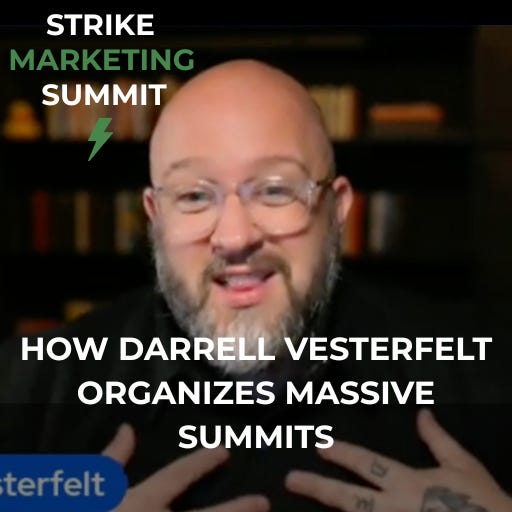
From Darrell Vesterfelt’s session at the Strike Marketing Summit
The Funnel Is Tired. People Are Tired. And frankly? So are most growth strategies.
That’s why Darrell Vesterfelt’s session at the Strike Marketing Summit was so refreshing.
Darrell is a speaker I’ve been trying to get for a whole year, and when he said “yes” to speaking at the Strike Marketing Summit, I was ecstatic.
He was an early Copyblogger partner with Brian Clark. He was director of growth at Kit (formerly ConvertKit), leading their meteoric rise through webinars. He is currently the VP of Growth at Mighty Networks, helping them grow through summits and challenges.
And he organized a 180,000-attendee, five-day summit to launch the School of Traditional Skills.
So him saying “yes” was a total coup for me - and for attendees at the Strike Marketing Summit.
What follows are the 10 principles Darrell shared about his time at Kit, organizing massive summits, as VP of Growth at Mighty Networks, and multiple seven-figure launches.
Principle 1: Webinars Work Because Live Presence Compresses Trust
Darrell didn’t start with summits. He started with webinars back in 2012 or 2013.
He told me he taught his first webinar at his kitchen table. He stacked up some books to prop up his laptop, got some contraptions and lights going, and just did it.
Why? Because his friend Jeff Goins was having success with webinars and Darrell thought, “I’m gonna try this.”
That first webinar? It just worked.
So he kept going. When he became head of growth at ConvertKit (now Kit), he taught 150 webinars in 12 months. And let me reiterate: webinars were not trendy. They just worked.
When someone shows up live - voice, face, ideas intact - it creates belief at scale in a way that static content never can.
Principle 2: A Summit is a Webinar on Steroids
Here’s how Darrell explained it to me: A webinar happens over an hour and it’s usually about one topic.
But a summit? That’s different.
When Darrell and his partners Josh and Carolyn Thomas were launching the School of Traditional Skills in 2022, they needed to make a splash. They’d raised over a million dollars from investors and they needed to hit the ground running.
They were sitting in a conference room in Bonners Ferry, Idaho - a town of 2,000 people in the most northern part of Idaho - trying to figure out their wildest guess for registration numbers.
They landed on 50,000 as their stretch goal. Something that would really make them push.
So they decided to create what Darrell called a “spectacle” (though he said that’s the wrong word). Four or five speakers a day for four days. Twenty speakers total. Streaming basically all day.
They spent nine months building this plan. They lined up the biggest names in homesteading - Joel Salatin, Justin Rhodes who had a million YouTube subscribers, all the heavyweights.
Nobody had ever done anything like this at that scale in the homesteading industry.
The result? 101,000 registrations. They blew past their 50,000 stretch goal.
And immediately after the summit? 5,000 paid members signed up for their company.
A week before the summit, nobody had heard of them. A week after, tens of thousands of people knew who they were.
That’s the leverage of a summit.
Principle 3: If They See What You Do For Free, Selling Gets Easy
One comment kept showing up in the chat during that School of Traditional Skills summit.
Darrell told me people would say: “If they do this for free, I can’t imagine what happens when I pay.”
That’s the sound of sales resistance collapsing.
You’re not overserving to be generous. You’re pre-selling without pressure.
By the time you make the offer, the decision’s already been made emotionally.
Principle 4: Borrowed Audiences Beat Paid Ads Every Time
When Darrell was at ConvertKit, they didn’t have money for ads.
As he put it: “We didn’t have two pennies to rub together.”
So what did he do? He borrowed trust through affiliates, partners, friends with audiences. Revenue share instead of ad spend.
He taught webinars for rooms of 1,000 people. And he taught webinars for rooms of three people.
He told me: “I didn’t care. If there was a room, I’d teach.”
That’s the mindset. Distribution before dollars.
And that’s why the channel worked.
Principle 5: Product-Market Fit Comes First - Always
This is where Darrell got really clear about what most teams get backward.
They push harder when things don’t move.
But here’s the metaphor Darrell used that I can’t stop thinking about: “It’s the difference between pushing a boulder uphill... and pushing it downhill.”
At ConvertKit, Nathan Barry spent three years barely making money. He was building a product he personally needed.
When Darrell arrived as head of growth, product-market fit already existed. The webinars didn’t create the growth. They released it.
If the boulder isn’t rolling on its own, more force just burns calories.
Principle 6: One Channel That Works Beats Eight That Don’t
After they found product-market fit at ConvertKit, Darrell made a decision that most growth teams are afraid to make.
He went all in on webinars.
That one channel drove $4.2 million in annual revenue. Over half the company’s growth came from webinars alone.
Everything else - blogs, podcasts, content - came after momentum existed.
Most teams diversify too early. Winning teams double down.
Principle 7: Challenges Are the New Summits
Summits create belief. But challenges? Challenges create momentum.
Darrell explained the difference like this: “A summit says: we’re here to teach you. A challenge says: we’re on a quest together.”
His favorite example was Justin Moore’s $10K Brand Deal Challenge.
Seven days. A small entry fee. Real outcomes before the big offer.
As Darrell put it: “People get results before they ever buy. All the objections disappear.”
That’s not a funnel. That’s proof.
Principle 8: Community Might Be the Most Underrated Business Model Right Now
This was wild to hear from Darrell.
He told me: “I used to think community was the worst business idea.”
He thought it meant creating content on a treadmill you could never get off of. But then he learned the Mighty Networks approach and completely changed his mind.
You don’t need a massive audience. You don’t need to be a famous expert.
You need 30 people on a shared journey together.
“Thirty members is critical mass,” Darrell said. “That’s about $15,000 a year.”
And when Kevin McGrew (who spoke right before Darrell at the summit) told me to start a community, I said “yeah, yeah, that’s cool” and ignored him.
But after hearing Darrell break it down, I turned to the camera during his session and said: “Kevin, you were right. I’m sorry.”
Community isn’t content delivery. It’s transformation infrastructure.
Principle 9: People Pay For Results, Not Features
Darrell was blunt about this.
“People don’t pay for features. They pay for results.”
That’s why Mighty Networks teaches community design before software usage. Tools without outcomes are just noise.
At Mighty Networks this year, they’ve shipped 117 new features. But Darrell doesn’t lead with that.
He leads with the results their customers get. Over the past year, they’ve helped more customers build million-dollar communities than any other platform.
As he put it: “If you can help people see change, you’ll be in business a long time.”
Features compete. Results evangelize.
Principle 10: Stay in the Tension Until You See the Twinkle
This was my favorite part of Darrell’s session.
He said: “Pull the slingshot back as far as you have to to find the product-market fit. It may feel like you’re going backwards, but as long as you’re continuing to find that moment where...”
And then he paused and looked at me.
“Fernando, I think I saw a twinkle in your eye about community today. I think it might have changed your mind about community.”
That twinkle. That’s the signal.
Not dashboards. Not vanity metrics. The moment someone leans in. When their eyes get a little wider.
Darrell quoted Seth Godin on this: “If you can create a song that one person starts tapping their foot to, then 10 people will. And then a hundred people will, and a thousand people will.”
That’s product-market fit.
Stay in the tension until you find that moment. Because everything after that feels automatic.
The Real Flywheel
Events create belief.
Community sustains momentum.
Product-market fit turns effort into inevitability.
Funnels extract. Flywheels compound.
That’s what I learned from Darrell’s session at the Strike Marketing Summit.
And if you’re done pushing boulders uphill, you already know what to do next.


