


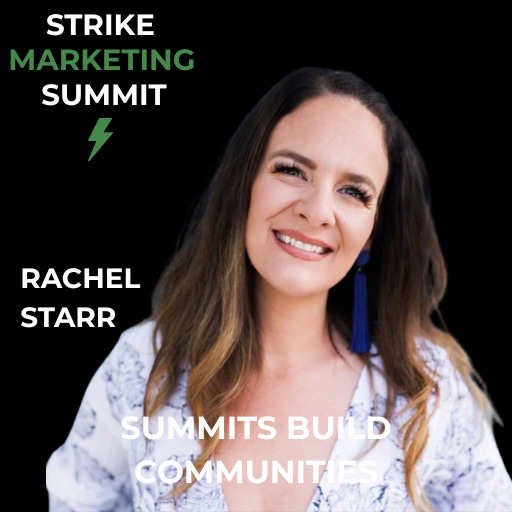
The Strike Marketing Summit was amazing. Great speakers. Solid content. But the chat was dead by Day Two.
Rachel’s entire session was about why that happens — and why it has nothing to do with the quality of your content.
WHO RACHEL STARR IS
Rachel Starr is a community strategist and the founder of Co-Creator Society, a membership built for entrepreneurs who are tired of building alone. She’s a Circle Certified Partner who works one-on-one with top creators and organizations to build high-performing community experiences. She’s been running and consulting on virtual summits for over two decades — first as a wedding planner who learned the hard way what experience design actually means, then as a community builder who took those lessons online.
What Rachel shared that day reframed how I think about every design decision a summit host makes — and why the ones that seem smallest often matter most.
THE EXPERIENCE PROBLEM
Rachel started with a diagnosis that, once you hear it, you can’t unsee it.
Most summits fail not because the content was bad, not because the speakers weren’t talented, but because the experience wasn’t designed with actual humans in mind.
She broke it down into four symptoms she sees over and over:
Cognitive overload. Too many sessions, too much information, too many calls to action. Attendees hit a wall by lunchtime. “People don’t remember what they learned,” Rachel said. “They remember how drained they felt.”
Disappearing attendees. People register with good intentions. When the summit feels chaotic or impersonal, their brain says this is too much and they quietly opt out.
Disconnected speakers. Speakers can feel when the room is cold. When there’s no chat energy, when the audience is passive, it affects the delivery. A disengaged room creates disengaged speakers creates disengaged attendees — a loop that compounds fast.
Flat conversions. The one no one likes to talk about. You pour your soul into the thing and the conversion rate looks like a parking lot on a Sunday morning.
None of these are content problems. They’re connection problems.
“Summits fall flat because they’re built around information instead of intention. But the moment you shift your mindset from ‘how do I deliver content’ to ‘how do I create an experience that moves people forward’ — everything changes.”
That sentence is the whole talk, compressed.
THE CONVERSION GAP NOBODY EXPLAINS
Here’s the number Rachel dropped that I haven’t been able to stop thinking about: some summits convert 2% of their attendees. Others convert 20%. With the exact same topic, the exact same niche, roughly the same speaker quality.
The variable isn’t content. It’s connection.
When attendees feel connected to the host, to the speakers, to each other — they show up more, they comment more, they stay longer. And engagement, Rachel was clear, is the single best predictor of conversion.
The logic runs deeper than that. Belonging builds trust faster than any other mechanism available to a summit host. When an attendee thinks these are my people or this host actually gets me — the entire relationship with your brand shifts. They’re no longer evaluating your content. They’re inside your world.
And once attendees feel that connection, the summit stops being a three-day event. It becomes the beginning of a long-term relationship — the front door to everything you’re building.
“A summit is not a content strategy. It’s a community strategy. Content informs and community transforms.”
WHAT RACHEL ACTUALLY BUILT
The strongest part of Rachel’s session was the walk-through of her own Co-Creator Growth Summit, which she ran in October — and intentionally used to simultaneously launch her new proprietary app.
Every structural decision she made is worth examining.
One unified hub. Everything lived inside her Circle community, accessible via desktop and her app. No Zoom link buried in email. No patchwork of tools. Attendees watched sessions, joined live panels, and dropped takeaways in chat — all in one branded space. The result: “People kept mentioning how thoughtful the design and their journey was.” Ease is a growth strategy.
Eight to nine sessions per day, roughly 20 minutes each. This wasn’t arbitrary. She designed the session load to be consumable for a free attendee — enough value to keep them engaged daily, not so overwhelming they burned out. The 24-hour access window (after which sessions came down for free attendees) created daily momentum and a natural, non-pushy reason to consider the all-access pass.
Live daily panels as the main connection engine. The prerecorded sessions delivered information. The panels created the actual human energy. Speakers showed up live, attendees interacted in real time, and “the conversations felt dynamic and rooted.” The panels, Rachel said, were where the magic happened — where attendees connected with personalities, not just content.
Daily chat threads with speaker drive-bys. After sessions dropped each morning, a dedicated chat thread opened. Attendees shared takeaways. Speakers popped in throughout the day to respond, connect, and build on what attendees had said. This kept the summit alive and social without requiring in-session chat on every video.
Private podcast feed — for free attendees too. Most summits that offer a podcast feed make it an all-access exclusive. Rachel offered it at 24-hour increments to free attendees as well, so they could listen in the car, on a walk, or during chores. The result: 25% of her total listenership came from the private podcast. It was, she said, their most loved feature by far.
The summit didn’t end on the final day. It rolled directly into open enrollment for the Co-Creator Society — using the momentum, connection, and trust built during the event as the launchpad. Attendees didn’t feel pushed into the membership. They’d already been in Rachel’s world for three days. The invitation felt like a natural next step.
THE CONNECTION-FIRST FRAMEWORK
Rachel pulled everything into a five-part framework she uses with clients. Each element is simple. Together they’re the difference between a summit that generates a list and one that generates a community.
1. Attract aligned speakers. Speakers aren’t just content contributors — they’re what Rachel calls “energy setters, tone carriers, and community builders.” When their values align with yours, their delivery becomes conversational. They want to interact with attendees beyond their session slot. They amplify the event naturally. Speaker alignment is your first lever of connection — and it starts before you even post the application.
2. Design for interaction, not consumption. This is the biggest structural shift. Most summits are designed like online courses: watch this, then that, then this. But interaction is what creates memory, connection, and ultimately conversion. Live panels. Chat threads with reflection prompts. Speaker drive-bys in the comments. “When attendees participate, they become engaged — and engagement is where transformation and conversions happen.”
3. Build one simple home base. “Your summit should feel like a space, not a collection of links.” A unified hub creates psychological safety. When people aren’t confused and aren’t hunting for the next thing, they stay longer, engage more, and feel more connected to the event overall.
4. Create built-in connection moments. And here’s the line I’ll be quoting for years: “People don’t need a 30-minute networking session. They need a 32-second moment of feeling seen.” A speaker replying to someone’s takeaway. The host acknowledging a shared struggle. Someone’s comment being echoed back by a stranger. These are the moments people remember. Design them in deliberately.
5. Use the summit as a launchpad. When attendees feel connected and supported and inspired, the next step becomes obvious. You’re not pitching — you’re leading. “A summit isn’t the finish line. It’s the beginning of the relationship.”
THE THING MOST HOSTS GET BACKWARDS
Rachel mentioned something in the Q&A that I think is the most actionable tactical insight in the whole session: she curates her topics first and reverse-engineers her speakers to match.
Most hosts find great speakers and let them pitch whatever they want to talk about. Rachel defines exactly what she wants covered on each day, writes the session title and description herself, and then recruits speakers to fill those specific slots — with a speaker agreement that spells out what they can and cannot do.
The effect is a summit that stays on brand, attracts exactly the right audience, and converts at the rates she needs — because every element of the content was designed backward from the community she’s trying to build, not forward from whoever agreed to speak.
“I curated all of that with the thought process of: this is my ideal member inside the Society, and this is the content they want to know.”
WHAT THIS MEANS FOR YOU
If you’re planning a summit, or you’ve run one that didn’t convert the way you hoped, the diagnosis Rachel offers is clarifying:
The problem almost certainly isn’t your topic, your speakers, or your production quality. It’s that the experience wasn’t designed to create the moments of connection that move people from attendee to believer.
Two things to do before you build anything else:
Start with the community you want to grow — not the sessions you want to run. Who do you want in the room? What do you want them to feel? Where does the summit lead? Design outward from those answers.
Then plan connection moments before you plan content. Where will people interact? How will attendees be seen — not just educated? How will speakers engage beyond their session? Build those moments into the structure first. The content fills in around them.
One more thing Rachel said that Marcus needs to hear: “People don’t remember how many sessions you had. They remember how your summit made them feel.”
That feeling is a design choice. Make it deliberately.
Rachel Starr: [Connect with her on LinkedIn] | Co-Creator Society: [cocreatorhq.com] | Community at Heart podcast: available wherever you listen
Ready to talk through how to design your summit for connection from the ground up? Book a free 30-minute strategy call
— Fernando Labastida Founder, Strike Marketing Institute
P.S. Rachel also walked through her exact summit marketing timeline (1-month runway, speaker promotion accountability tracked publicly inside her community, Deadline Funnel sequence for immediate upsell on registration), her speaker agreement template, and how she's built a membership community that people actually stay in. The full replay is available for summit registrants.


