


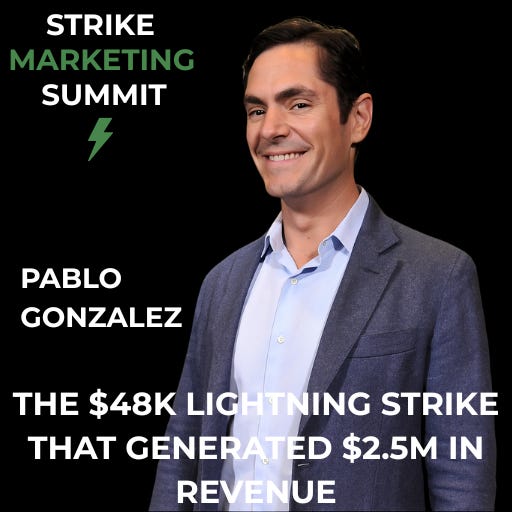
Pablo Gonzalez is the Chief Evangelist at Vendoroo, an AI maintenance solution for the property management industry, and founder of BetheStage, a marketing agency built around content co-creation. In this Strike Marketing Summit session, Pablo walked through how he designed a category, built an alliance of AI companies, secured a free 2,400 sq ft room at the industry’s biggest conference, and generated $2.5M in closed-won revenue in 36 hours on a $48K budget. Connect with Pablo on LinkedIn.
Most founders show up to conferences with a booth, a banner, and a bowl of candy. They make eye contact with strangers, hand out business cards, and fly home with a spreadsheet of “leads” that will never convert. They spend $20,000 or $50,000 or $100,000 and the best they can say afterward is “we had some good conversations.” The pipeline impact is unmeasurable because there isn’t one.
Pablo Gonzalez showed up to the Broker/Owner conference in property management and spent $48,000 — roughly what a mid-tier booth package costs at most B2B trade shows. He walked away with $2.5 million in closed-won revenue in thirty-six hours. Not pipeline. Not “qualified leads.” Closed-won revenue. The difference between Pablo’s approach and the booth-and-candy approach isn’t budget. It’s architecture. Every dollar he spent was in service of a specific transformation he wanted attendees to experience, and every element — from a roaming AI robot to a pair of Meta Ray-Ban sunglasses — was engineered to drive that transformation forward.
What Pablo shared at the Strike Marketing Summit wasn’t a highlight reel. It was a complete operating manual for what he calls a “lightning strike” — a concentrated, time-bound takeover of an existing event that compresses months of relationship-building and pipeline development into days. And the principles behind it apply to any founder trying to break through a revenue plateau, whether you’re spending $48,000 or $4,800.
Who is Pablo Gonzalez?
Pablo’s obsession with community-driven business development started ten years ago at his brother’s funeral, when 1,200 people showed up and gave him a visceral understanding of what real community means for the people inside it. He spent the next decade proving that community creation — not advertising, not cold outreach, not content marketing as typically practiced — is the highest-leverage business development mechanism available. He built a $40 million sales channel for a real estate development company. He created the largest community event in the property management industry. He turned a podcast into a business development engine that got him written about in The Ultimate Sales Machine and connected him with the architects of category design — Kevin Maney, Mike Damphousse, and Christopher Lochhead — as peers and collaborators, not fans.
When the AI maintenance startup Oo saw what Pablo was building in property management, they brought him in as Chief Evangelist with equity in the company. His job: design a category and win it. What he did next is the story he told at the Summit, and it reframed how I think about what’s actually possible when you combine category design with content co-creation and a willingness to engineer experiences instead of just buying impressions.
The POV That Made Everything Else Possible
Before Pablo built anything — before the pavilion, before the partnerships, before the revenue — he built a point of view. And this is where most founders get the sequence wrong. They start with the product. They start with the features. They start with the demo. Pablo started with a story about the world.
The point of view he crafted for Oo centered on something every property manager already knew but hadn’t articulated as a category-level problem: maintenance is the number one driver of negative Google reviews in property management. Not leasing. Not communication. Not fees. Maintenance. When a toilet breaks at 2 AM and the response takes three days, the tenant writes a one-star review. When that review shows up on Google, it doesn’t just hurt the property manager’s reputation — it affects their ability to attract new owners, retain existing ones, and compete against the VC-backed property management companies that can afford dedicated maintenance coordination teams. Pablo called this the fundamental unfairness of the system: property managers were being punished on Google for a problem they didn’t have the staffing to solve, and the conventional response — hire more people, add more process — couldn’t scale because the economics of property management don’t support it.
That narrative did something critical. It shifted the conversation from “here’s our AI product” to “here’s why the world is unfair to you, and here’s what a different future looks like.” As Pablo put it during the session: “When you have a good POV, it provides the perfect frame for a conversation for your content stream. You’re talking about the problem, not about your solution. And when you’re talking about the problem and you have a great solution for it, there’s always going to be an opportunity to tie it back to yourself — in a non-salesy way.”
That point of view became the organizing principle for everything that followed. The podcast interviews validated the pain. The AI Alliance summit socialized the narrative. The conference takeover crystallized the transformation. Without the POV, every one of those activations would have been a product pitch. With it, they were chapters in a story the audience was already living.
The Content Co-Creation Engine: Podcast as Trade Show Booth
The mechanism Pablo used to build distribution, validate pain, and create allies simultaneously is deceptively simple: he showed up to industry conferences with cameras and lights, and instead of selling, he interviewed people. He calls it “podcast as trade show booth,” and it’s the closest thing I’ve seen to a cheat code for breaking into an industry where you don’t yet have credibility.
Here’s how it works in practice. You show up to a trade show. Instead of a booth with a banner and a fishbowl for business cards, you set up a podcast recording station — lights, cameras, lavalier mics, a couple of tripods. Pablo noted you can do this with nothing more than an iPhone, a tripod, a dual-input adapter, two lav mics, and two LED lights. When you want more production value, you hire a local videographer for their day rate and equipment, and handle post-production in-house. While everyone else at the conference is dodging eye contact with booth vendors, people are drawn to lights and cameras like moths. “When you have lights and cameras and people speaking,” Pablo said, “people are walking by like, ‘Whoa, who’s on TV? Should I know that person?’” Your team intercepts the curious ones, asks what they think about the topic, and invites the best ones on camera.
But the genius of the model isn’t the recording — it’s what happens afterward. Pablo’s offshore editing team in the Philippines turns around sizzle reels for each guest overnight. The next morning, each interviewee gets a professionally edited clip of themselves looking like an industry expert at a major conference. They post it. Their network sees it. Your brand is attached to every single one of those posts. You’ve just created dozens of micro-distribution channels — all pointing back to your narrative — without spending a dollar on ads. And you’ve done it by giving something valuable to people who hold the keys to the doors you want to open, which is Pablo’s operating principle for everything: “Find a way to serve the people with the keys to the doors you want to open.”
Through this content co-creation model, Pablo built relationships with the coaches, advisors, and broker-owners who ran the property management industry’s social ecosystem. He validated the maintenance-and-reviews pain point through dozens of on-camera conversations. And he accumulated enough social capital and borrowed credibility to attempt something most newcomers to an industry could never pull off: taking over the industry’s biggest conference.
Securing the Room: The NARPM Partnership
The most expensive thing about a conference takeover is the space. Pablo got his for free — a 2,400 square foot room at the Broker/Owner conference, provided by NARPM (the National Association of Residential Property Managers) as part of a content partnership. The deal was straightforward: NARPM had educational accreditation programs they wanted to promote. Pablo offered to create content featuring those programs, with Oo sponsoring the production. NARPM got free marketing for their designations. Pablo got a massive room to activate. Neither side paid the other. Both sides got what they needed.
This is borrowed credibility at scale. NARPM’s endorsement — implicit in the partnership — gave Pablo and Oo legitimacy they couldn’t have bought. The space wasn’t branded as “Oo’s booth.” It was branded as the “AI Pavilion,” presented as an industry resource, and positioned as the place where the future of property management was being demonstrated. The distinction matters enormously. A booth says “we’re selling something.” A pavilion says “something important is happening here, and you should be part of it.”
The AI Pavilion: Designing a Transformation
With the room secured five weeks before the conference, Pablo had to activate it. Every element he chose was reverse-engineered from a single “from-to” — the transformation he wanted attendees to experience. He wanted people to walk in thinking “AI is a technology tool” and walk out believing “AI is ready to be hired as a teammate.” That’s the from-to. And it governed every decision.
The space opened with a twenty-foot circular structure displaying quotes about AI — not from Oo executives, but from podcast guests, AI Alliance founders, and figures like Satya Nadella and Tim Cook. The effect was status attribution through association: this isn’t a vendor space, this is where serious people are talking about serious things. Inside, anthropomorphized cardboard cutouts of Oo’s AI agents — designed to look like “daft punk bunnies,” as Pablo described them — greeted visitors with their job titles. A receptionist agent. A troubleshooting agent. A dispatch agent. Attendees could interact with each one at dedicated demo stations, experiencing first-hand what AI-as-teammate actually felt like in practice.
At each demo station, a tablet below the computer ran a Snapchat-style filter that superimposed Oo’s logo onto the visitor’s face — “This is you inside the computer. We’re making an AI version of you.” Playful, memorable, and reinforcing the from-to narrative at every touchpoint. After the demos, visitors were asked a carefully designed research question: “If someone showed up on day one with this skillset and told you they’d keep getting better, never take a day off, never quit, and never be cranky — how would you rate them as a hire?” The results displayed on a screen at the exit: 76% of property managers rated agentic AI as an A-level hiring prospect. Eighteen percent said B-level. Six percent said C. Zero said below average. Pablo had just generated original market research — in real time, at the conference — that told the story he wanted the industry to hear. And every attendee who participated now had a personal stake in the data.
Outside the pavilion, geo-targeted Facebook ads blanketed the conference zip code: “If you want to learn about AI at Broker/Owner, come to the AI Pavilion.” A roaming AI robot photo booth wandered the hallways, taking photos of attendees, generating AI-enhanced portraits, and directing people to the Pavilion to pick up their prints. And eight of Oo’s top evangelist clients received Meta Ray-Ban glasses in the mail before the conference with a personal note: “Since you saw the future and bet on us early, I want you to have the most futuristic glasses in the game.” Those eight clients walked the conference wearing the glasses, fielding questions from curious attendees, and generating organic word-of-mouth that no amount of advertising could replicate.
Total spend: $47,000. The AI Pavilion structure cost $12,000. The robot cost $7,000. Demo stands and production filled out the rest. The 2,400 square foot room was free. And the result was $2.5 million in closed-won revenue in thirty-six hours.
The Principles Behind the Strike
When Pablo stepped back from the story to teach the underlying framework, he identified four principles that made the lightning strike work — and that apply to any concentrated event activation, whether you’re spending $48K at a trade show or $5K on a virtual summit.
Principle 1: Distribution through social validation. Getting butts in seats isn’t enough. You need butts in seats that arrive with trust already built. Pablo’s distribution came from the AI Alliance (whose member companies promoted the Pavilion to their networks), the NARPM partnership (which gave the Pavilion institutional credibility), the podcast guests (who were featured on the circular structure and felt ownership of the space), and the evangelist clients (who wore the Ray-Bans and became walking endorsements). Every channel was socially validated — the audience didn’t discover the Pavilion through an ad. They heard about it from someone they already trusted.
Principle 2: A clear from-to. Pablo emphasized that events without a designed transformation are “just a cool thing that people forget.” Every great story has a journey, and every beat in that journey has its own from-to that advances the larger arc. For the AI Pavilion, the macro transformation was “AI is a tool” to “AI is a teammate.” The demo stations, the hiring question, the real-time survey results, the anthropomorphized agents — each was a beat that moved the attendee one step further along that journey. The constraint of having a single, clear from-to is what made the creativity purposeful rather than scattered.
Principle 3: Wow moments that create word of mouth. The robot. The Ray-Bans. The AI photo filter. The live survey results displayed on a screen. These weren’t gimmicks — they were engineered to be the kind of thing people pull out their phone to photograph and text to a colleague. Pablo allocated budget to moments that would generate organic amplification, not to impressions that would be forgotten by lunch.
Principle 4: A content co-creation engine as the foundation. This is the meta-lesson, and Pablo was emphatic about it: none of the rest was possible without the content co-creation engine he’d built over the preceding months. The podcast interviews created the relationships. The relationships created the partnerships. The partnerships created the distribution. The distribution filled the room. “I cannot understate how valuable it is,” he said. “Having the ability to post-edit content and create content for people — that is the magical juice of distribution and finding alliances and getting that social validation.”
What This Means for You
If you’re a bootstrapped founder stuck at a revenue plateau, the instinct is to spend more on the things that got you here — more ads, more cold outreach, more conference booths. Pablo’s story is a case study in why that instinct is wrong and what the alternative looks like.
The alternative is architecture. Start with a point of view that names a problem your market feels but hasn’t articulated. Use content co-creation — interviews, podcasts, collaborative events — to validate that pain, build relationships with the people who matter in your industry, and create socially validated distribution channels. Then, when the moment is right, concentrate everything into a lightning strike that compresses months of relationship-building into days.
You don’t need $48,000. You need a POV, a camera, and the willingness to serve people with your superpower before you ask for anything in return. The podcast-as-trade-show-booth model costs almost nothing to start. The relationships it builds are worth everything.
As Pablo put it: “Anybody that wants to create a lightning strike or take over a category — you’ve got to figure out how to not just become a publishing engine yourself, but how to empower other people to publish things based on the narrative that you’re telling.”
That’s the content cascade in action. That’s Strike Marketing.
Connect with Pablo Gonzalez: LinkedIn
Until next time — stop being invisible.
— Fernando
P.S. Pablo mentioned that within 12 to 24 months of starting a content co-creation engine — podcasting, side events, panels — any founder will have all the ingredients needed to host their own event. If you’re wondering where to start, that’s the sequence: POV first, then podcast, then partnerships, then your own lightning strike. The path is the same whether you’re in AI, consulting, SaaS, or construction.


