

Events As Post-AI Trust Infrastructure
In a world devoid of trust, this is the last trust mechanism left

“More doctors smoke Camels than any other cigarette.”
That was a real line, the hook from an iconic ad campaign launched by R.J. Reynolds in 1946, which ran until 1952.
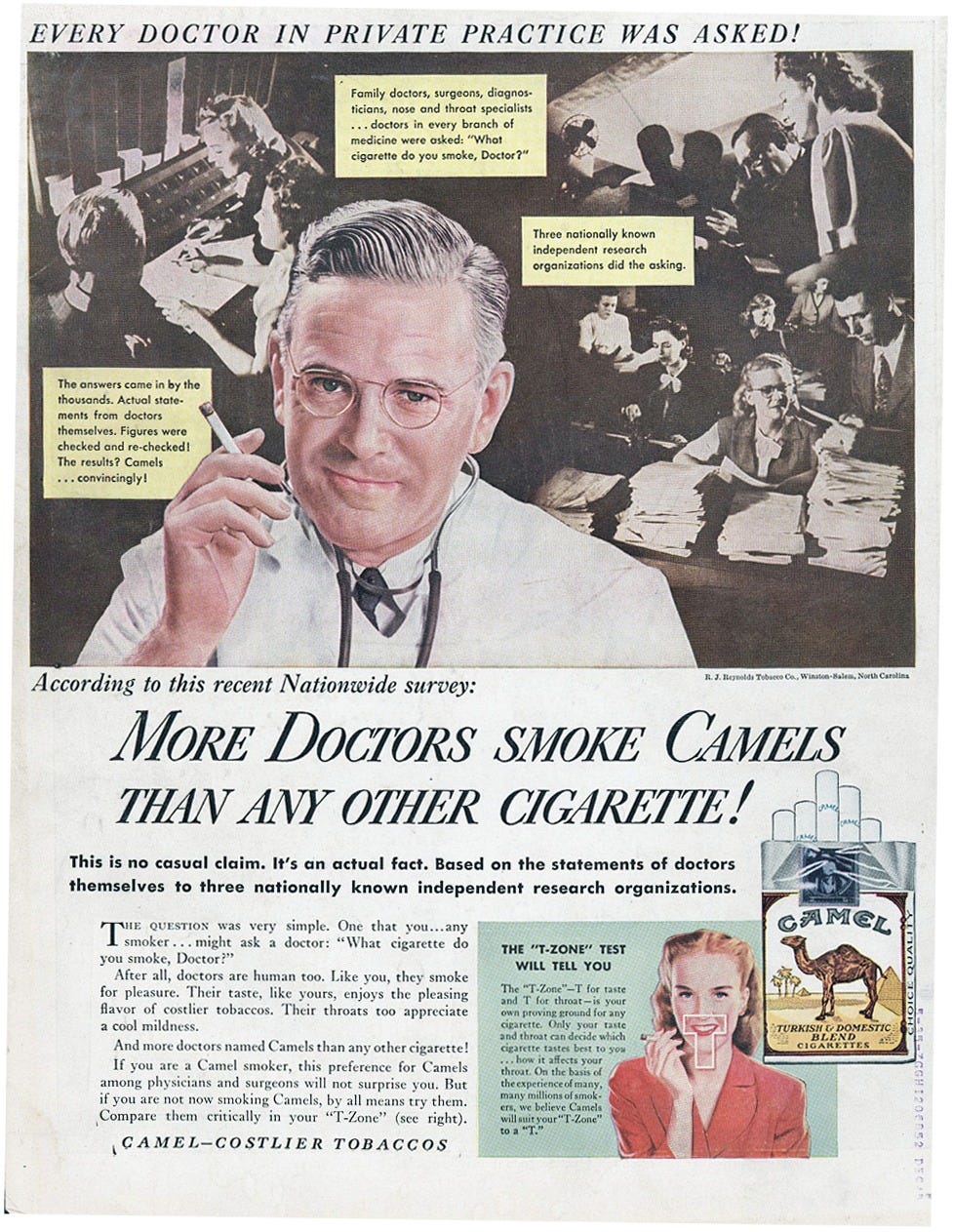
Amazing that was an actual advertisement.
The advertising agency that designed the campaign knew they needed to generate trust with the public, and who better to convey that trust than your friendly neighborhood doctor (with glasses, rosy cheeks, and a cigarette).
But as we all know, that was false advertising. Criminally false advertising.
It broke that sacred trust they had forged with the audience, and contributed to a rise in lung cancer, emphysema, and chronic bronchitis (let alone the decline in trust in the marketing profession during the advertising age).
We’re at that point again, but not because the marketing industry is deliberately deceiving the public despite dozens of well-researched, peer-reviewed studies about the dangers of cigarettes, as was the case in the ‘50s and ‘60s.
We’re at that point because of AI.
Now, don’t get me wrong. I’m very AI forward. I use Claude Cowork to run my business: I’ve built websites with it, it keeps me on track with my weekly tasks, I organize myself with AI, I write proposals with it, etc.
I feel like I’ve dialed in how to use AI to help my marketing consulting business in an appropriate, ethical way.
And I’ve learned how to put the appropriate guardrails on.
I believe AI should be there to amplify our own unique humanity, intelligence, insights - our DNA - not replace it.
But AI has run amok in our content feeds.
I was at an AI meetup the other day, and one of the attendees told me (this guy is a really talented GEO/AEO expert) that he’s just sick of all the AI slop filling up his LinkedIn timeline.
I had to agree…which was ironic, since we are both AI-forward marketers at an AI event.
But AI has eroded trust.
A recent TechRadar article (appropriately titled: “It’s not just you — LinkedIn is being flooded by awful AI-generated posts, and tech workers are particularly bad at it”), published a summary of a Publicate study from January of this year that said that out of 1,000 LinkedIn posts, 73% of finance posts were AI-generated, followed by 57% of technology posts, and 54% of legal posts.
It’s gotten so bad that LinkedIn decided to take action.
LinkedIn’s VP of Global Editorial, Laura Lorenzetti, said in a May 20th post,
“While AI can be a helpful tool for refining language, we’re seeing a rise in what many call “AI slop…” …To address this, we’re taking meaningful steps to crack down on automation tools, dial back on generic content, and strengthen authenticity.”
The AI era has given way to the ‘era of trust’
If LinkedIn is taking this type of action, you know thousands of users have complained about the AI slop in their timeline.
I’ve seen it myself. People who should supposedly know better have been using AI to write their posts without any kind of review or editing.
(And I’ve also seen brilliant marketers, founders, and CEOs use AI to make their posts authentic, a pleasure to read, and compelling).
A 2025 Edelman-LInkedin study said that only 32% of users actually trust AI-generated content.
There’s that word trust again.
You see, trust is the most important factor in marketing. And trust has become far more important today than before the AI-era (it was always important, it’s just more glaringly important now).
We’re at that “doctor recommending cigarettes” inflection point.
The rise of events as the new trust vehicle
How can you generate trust in today’s post-AI world?
I postulate that events are going to be the new trust vehicle in B2B marketing for 2026 onward.
Events took a nosedive during COVID, but since 2023 they’ve seen a resurgence.
Forester reported that 59% of B2B organizations planned more hosted events over the next 12 months, while Splash found that 88% of marketers see events as key revenue drivers.
There is more research than I have room for here, but the evidence seems to be pointing to events as an ever-more important tool in a B2B marketer’s arsenal.
As I was doing the research for this article, I asked myself this question: why are events so good at generating trust?
I didn’t want to resort to the pablum repeated everywhere:
“Authenticity,” “Engagement,” “Community.”
That’s just surface-level stuff we marketers repeat ad nauseam when we want to claim our marketing is real and human.
I wanted to go deeper. And I found something interesting: biology.
Yes, events trigger a biological reaction that helps marketers key into a phenomenon our ancestors have tapped into for thousands of years.
The biology of events
When I was a freshman in college, I went on a two-month volunteer trip to the Dominican Republic with a group called Amigos de las Americas.
The goal was to live in an impoverished rural area, implement a community sanitation program (aka: building latrines), and hopefully stop the fecal-oral transmission cycle of gastrointestinal diseases.
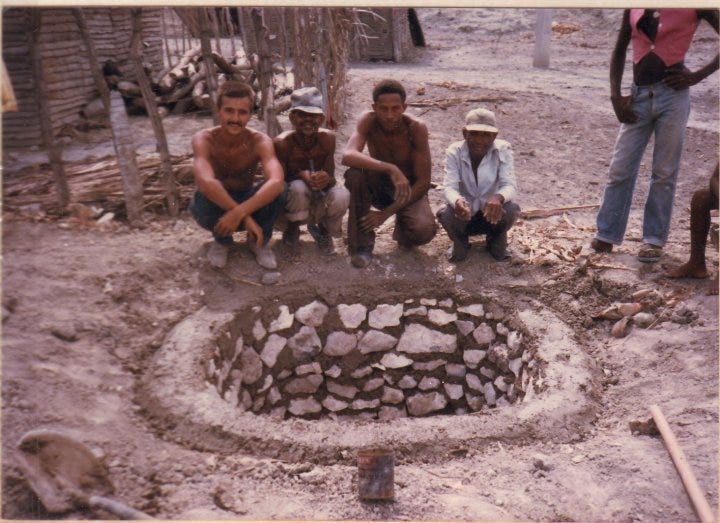
This was especially important because dehydration due to diarrhea is the number one cause of infant death in the developing world.
I was 19 years old. My partner, Laura, and I experienced culture shock as soon as we were dropped off in the village of El Salado, our home for the next two months.
But we adjusted, and the people from the village became our lifelong friends.
On my return to Texas, I experienced reverse culture shock. I couldn’t relate to the materialism, the minutiae that Americans called “problems,” and the lack of awareness of what’s going on in other parts of the world.
A year passed, and I joined Amigos again. When I went to Houston for leadership training (I had been promoted to route leader), I met up with so many colleagues I had worked with in the D.R.
It was like the time hadn’t passed.
We hugged, remembered funny stories (they didn’t seem funny at the time…like when I got sick and had the runs all day, waking up delirious at noon with a medicine man chanting ancient cures for me).
The feeling of getting back together with my fellow volunteers from Amigos de las Americas was unlike anything I felt before.
We had gone through experiences together that nobody else in our hometowns had ever experienced. We had forged a special bond during that summer of 1985.
Ok great, but what does this have to do with B2B marketing events?
Everything.
What I experienced with all those kids during the summers of 1985, ‘86, and ‘87 was something called collective effervescence.
Collective effervescence is a phenomenon coined by Émile Durkheim in 1912 to describe the intense shared emotional activation that emerges during collective rituals. The feeling of unity and aliveness that happens when people experience something together.
A 2022 meta-analysis published in Frontiers in Psychology confirmed that collective gatherings consistently produce heightened emotional states, blurred boundaries between self and other, and stronger social bonds.
The phenomenon is more than psychological; it’s biological.
A study measured heart-rate dynamics during a Spanish fire-walking ritual and found that participants, even spectators who were related to participants, showed synchronized heart-rate patterns.
And there are actual chemicals involved.
Oxytocin, the bonding hormone, is released during shared emotional experiences, producing synchronized biological responses between people.
Research from Ruth Feldman’s lab and others shows that oxytocin synchrony is the neurochemical signature of genuine bonding. It’s not just “feeling close.” Your nervous systems are actually coordinating.
Events and collective effervescence
An in-person event is a low-intensity collective effervescence event. But it still produces measurable bonding and oxytocin synchrony
A virtual summit is a shared journey. Participants go through something together over multiple days, which deepens that bond.
An in-person event activates the full biological stack: physiological synchrony, oxytocin release, and the beginnings of identity fusion
This is why no amount of AI-generated content can replicate what an event does.
Content is consumed alone. Events are experienced together, forming a biological connection between participants.
It’s where trust is generated.
You see, we’re biologically wired to join groups, go through rituals, chant together, learn together, go through painful things together.
While I don’t see B2B events bringing fire-walking or soccer chants to a venue near you any time soon, think about what you go through during an industry conference:
You sit in the crowd at a dynamic keynote given by a professional speaker who has a unique ability to excite the crowd.
You then go to a workshop at a breakout event, and work on problem exercises with the people sitting at your table.
At night, you might go to House of Blues and dance together (or participate in a silent disco like I did at CEX last year).
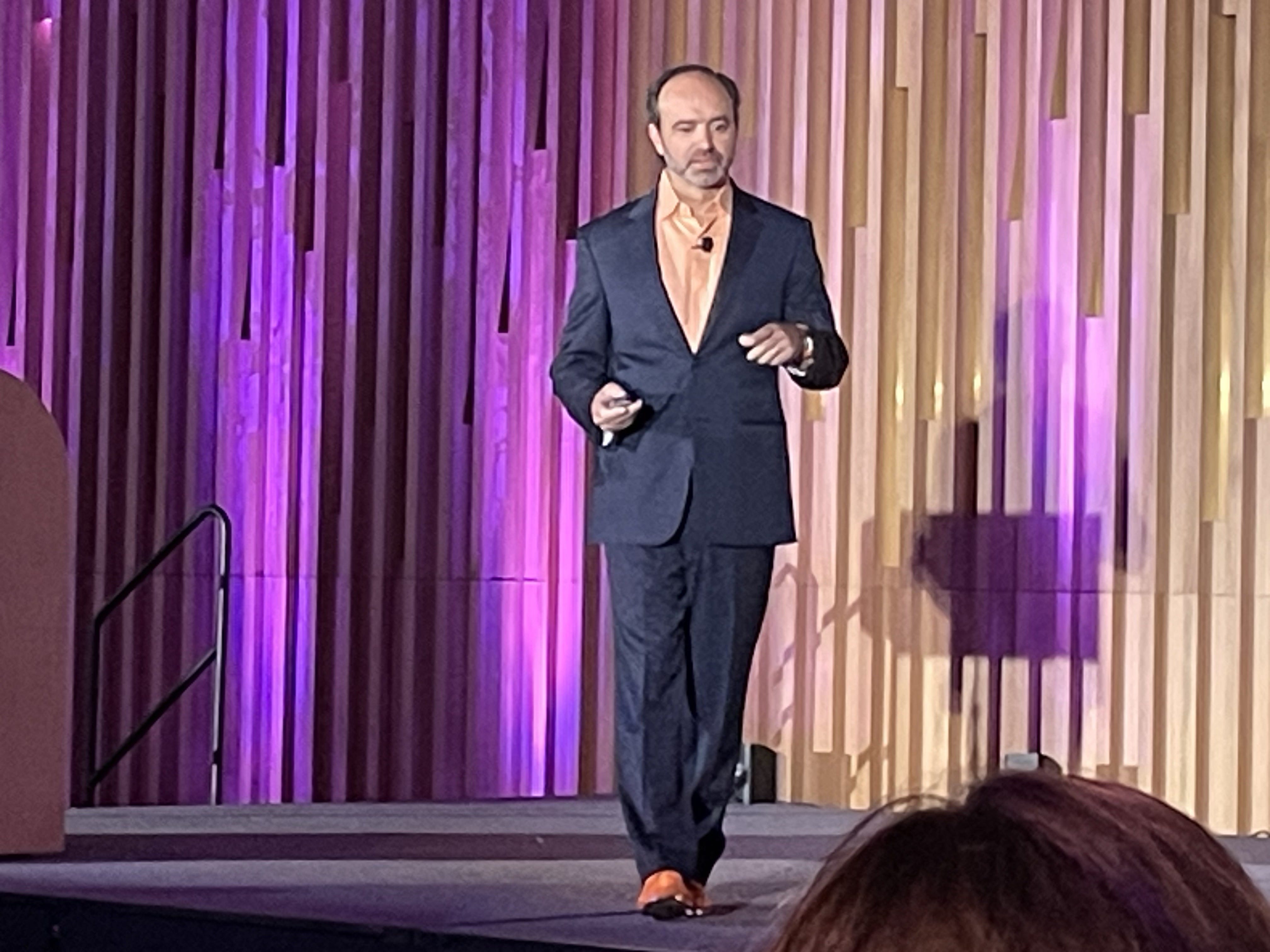
All of a sudden, you’ve bonded with everybody there! You shared your business goals with your tablemates. Had drinks with event goers at the hotel next door. Clapped together at Joe Pulizzi’s keynote address.
Now you’re liking each other’s posts on LinkedIn, getting on podcasts together, and buying each other’s products!
Events are the ultimate trust mechanism in this post-AI world.
Events as post-AI trust infrastructure
Paul Graham, founder of Y Combinator, exhorts incubated startups to “Do things that don’t scale.”
That’s shorthand for “doing difficult things.”
Events are scalable, especially if you organize a virtual event, but they’re difficult to organize. They require forging relationships with speakers, sponsors, all the people you need to organize a successful event.
You need to get people to register, pay money, then show up.
Then you need to book a venue, organize catering, and coordinate the booth space.
Contrast that to AI-produced content (or even AI-repurposed content).
AI makes things easy. It’s leveled the playing field. And that’s a beautiful thing.
But we all know it didn’t take a lot of effort.
It used to be difficult to write and publish content on a consistent basis. Not anymore.
But organizing an event is the last thing left that’s difficult. Your prospects see it, they know it implicitly.
And when you organize it the right way, you can engineer that collective effervescence that can bond your community to you forever.
That’s trust built into biology.
That’s the new post-AI trust infrastructure.
And I’ll be publishing a weekly newsletter essay about this.
Will you join me on this journey?