

Category-Led Marketing
Or Category-Led Growth

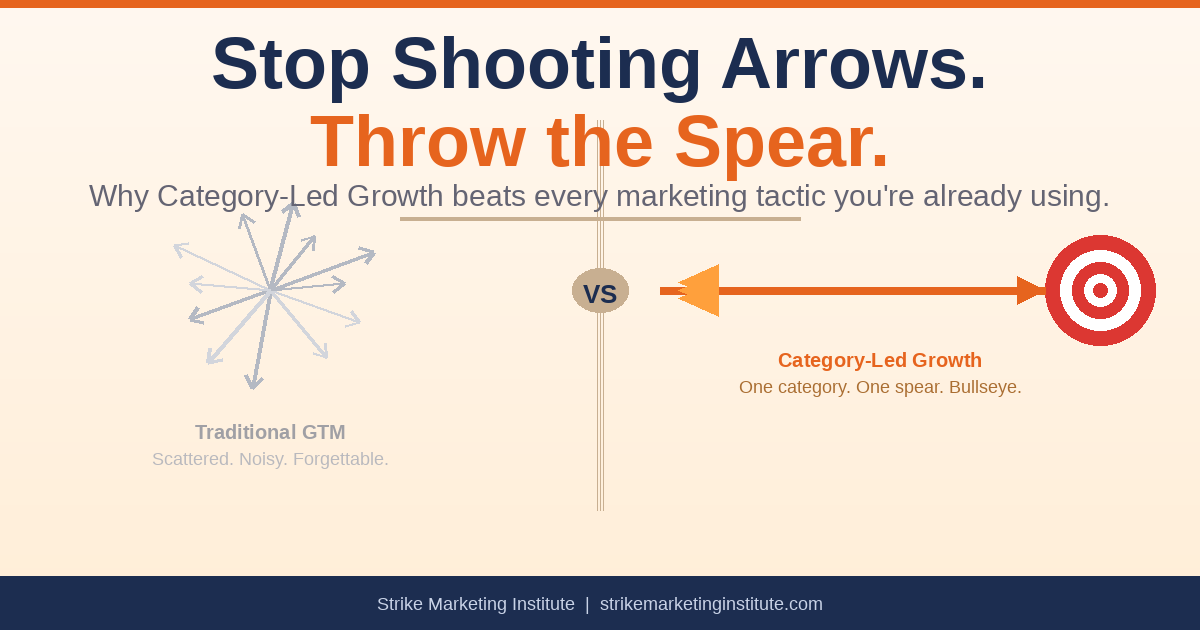
I was brainstorming with myself the other day…I must have looked crazy to anybody who sees me, because when I brainstorm, I turn on my phone voice recorder, and I talk into it like I’m on an animated phone call where passions are strong.
Except I’m talking to myself…and my recorder.
I was talking to myself about marketing, the existential issues around AI, and whether AI is helping marketing or making marketers redundant, and stuff like that.
It suddenly dawned on me: we’re not doing normal marketing.
In fact, the old go-to-market (GTM) playbook is pretty much obsolete.
You know what I mean, the traditional cold outbound email, cold DMs, content marketing, LinkedIn ads, Meta ads, trade shows, influencer marketing, PR, mindless boring webinars and events, etc.
None of that stuff matters because the reality of the situation is that everybody’s seen this movie before, a hundred times.
Everybody has seen every product, service, course, mastermind, offer, come-on, video, LinkedIn post, newsletter article...
It’s the broken record of digital marketing.
Which has now been given super-duper alien growth hormones in he form of agentic AI and LLMs and all that.
AI has created the solution and the problem.
Author and content marketer Robert Rose has a saying: “The invention of the ship also invented the shipwreck.”
The advent of AI has knocked down the final barrier to content creation and marketing, and business creation.
There is no excuse for anybody not to start a business and market their business using AI.
But this is also the problem.
Because if anybody can do it, then anybody can do it, which has created the sea of sameness that we’re all drowning in.
The solution is the problem.
And I’ve been seeing it with my own eyes at local chamber of commerce meetings, on LinkedIn, and with friends who have started AI-focused businesses.
These earnest entrepreneurs are just falling in love with what they can do with Claude Cowork and with Open Claw and with the whole Gemini suite of products.
Not to mention all the vibe coding tools like Lovable, Cursor Base44, and more.
I know a young woman who has vibecoded three really good apps already.
She loves vibecoding apps.
And that’s beautiful, and it’s also a problem, because with everybody creating fantastic apps and workflows with AI, and loving what they’re creating, they also create their own blind spots.
I’ll bring up another old saying:
“It’s better to fall in love with the problem and your client than to fall in love with your product.” Unfortunately, everybody’s falling in love with their product.
And everybody’s doing the same ol’ same ol’ marketing for their products they’ve fallen in love with.
Category Led Growth
And so many of these earnest, enthusiastic, and frankly beautiful entrepreneurs are taking a product-led growth approach because they sincerely believe in their heart of hearts that their product is so good that it will just attract people. They have the philosophy of “if you build it, they will come.”
But in reality, they’re just contributing to the sea of sameness.
Now I don’t want to discourage anybody here, but hear me out because there’s light at the end of the tunnel.
Going back to my crazy-looking brainstorming session where I was pacing around the my living room, arms were flailing around in enthusiasm, talking into my recorder. I had this hypothesis that I’m actually carrying out with two of my clients.
It’s called category-led growth.
I ran this idea by my buddy Chris Stanley, and he had a great way of putting it. I’ll share with you what Chris told me. (Thanks, buddy, for the mind picture).
In the traditional marketing approach, you have all these disparate marketing moves:
cold outbound
LinkedIn
Meta advertising
search engine marketing
PR
inbound marketing
content marketing
Think about these as different arrows in your quiver, and you are just shooting arrows randomly at your target.
But in category-led growth, you have a single spear, and that spear is large, accurate, and deadly.
What does the spear represent? It represents your own category. You have to build this spear piece by piece because it’s so big; you can’t just carve it out of a single piece of wood.
Each piece of the spear is:
the cold outbound
the LinkedIn
the Meta advertising
the search engine marketing
the PR
the inbound marketing
the content marketing
the lightning strikes
You see, with category-led growth or category-led marketing (you’re not promoting your company or your products; you’re promoting your new category).
And the good news is, this roadmap has already been drawn.
When Joe Pulizzi was building the Content Marketing Institute, he was blogging and speaking, and writing books about content marketing. He wasn’t talking about the Content Marketing Institute’s services or any of the services or products that he offered. He was just talking about content marketing.
When HubSpot started, they were talking about Inbound Marketing. They barely talked about the HubSpot platform (which, frankly, was kind of a dog at the beginning).
Joe and HubSpot were building their categories.
Because their category WAS their product marketing.
Their category was the target for their cold outbound, their LinkedIn content, their search engine marketing, PR, content marketing, and lightning strikes.
All these had one purpose: building their categories. And by the way, their categories pulled their products and companies into prominence by the sheer weight of gravity they created of their categories.
Because, as I said above, the category is the product marketing.
When you market your category, you set the rules for the products within the category. Any competitors that come later have to follow the same rules.
Each marketing move builds the powerful, deadly spear you’re building.
I’m talking about this next Tuesday, April 21, 12 PM CST.
Register now: https://tinyurl.com/summit-roi
See you there!